Parker Klein · 29 September 2026
Rural Hedgerow Revival Projects Create Stepping Stone Networks for Regional Bee Movement
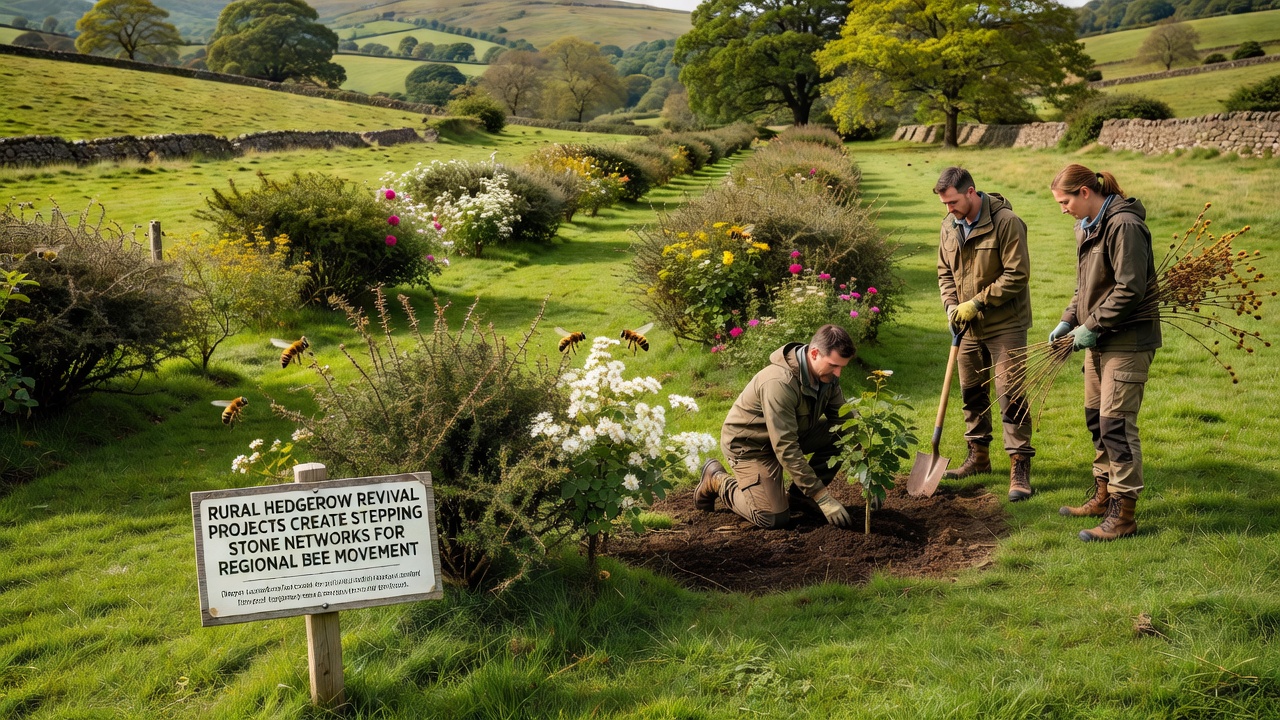
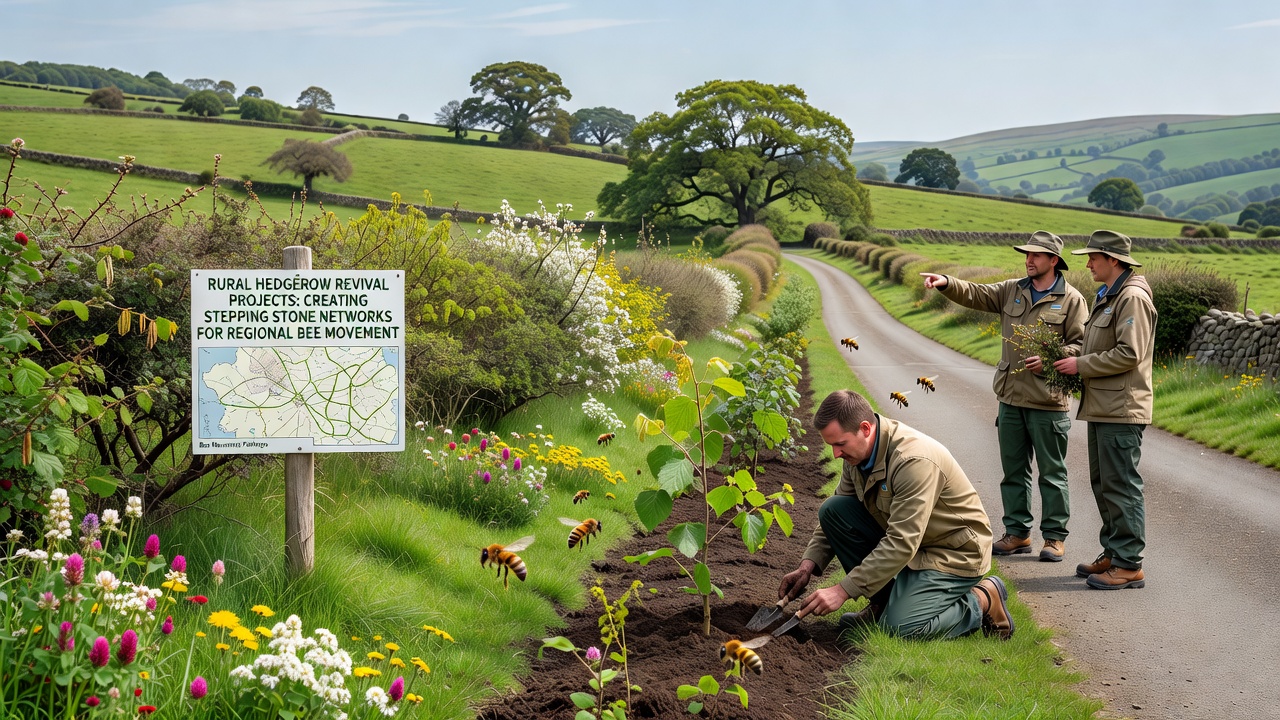
Researchers tracking pollinator patterns across agricultural regions have documented how hedgerow restoration initiatives establish linear habitat corridors that link isolated patches of flowering plants and nesting sites. These networks allow bee species to traverse distances that would otherwise remain fragmented by intensive monoculture fields and paved infrastructure. Data collected from multiple European and North American monitoring programs shows that restored hedgerows increase local bee abundance by 25 to 40 percent within three growing seasons after planting, according to field surveys coordinated through the European Environment Agency.
Landscape Connectivity Through Traditional Field Boundaries
Hedgerows originally planted as livestock barriers and windbreaks now serve an additional ecological role as transit routes for solitary bees and bumblebees moving between distant forage areas. Projects in the Midwest United States and the Loire Valley in France demonstrate that gaps between hedgerows narrower than 300 meters enable species such as Osmia bicornis to maintain viable populations across larger territories. Satellite imagery combined with ground-based bee counts reveals that continuous hedgerow lines reduce the energy expenditure bees require during dispersal flights, which in turn supports gene flow among previously isolated colonies.
Restoration teams select native shrub and tree species that bloom sequentially from early spring through late autumn, creating a sustained nectar and pollen supply along each corridor. In September 2026, a multi-year assessment scheduled for release by the Food and Agriculture Organization will compile results from 47 restoration sites spanning five countries, measuring changes in bee community composition before and after hedgerow installation. Preliminary data already indicate that corridors exceeding 1.5 kilometers in length support greater species richness than shorter fragments, particularly for long-tongued bumblebees that prefer deeper flowers found in mature hedge margins.
Species-Specific Responses to Corridor Design
Entomologists have recorded distinct movement behaviors among different bee guilds when hedgerows are present. Ground-nesting species such as Andrena and Halictus utilize the sunny south-facing edges of restored hedges for nesting burrows, while cavity-nesting bees colonize deadwood left within the hedge structure. Radio-tracking studies conducted in rural Ontario show that individual bees travel up to 1.2 kilometers along continuous hedgerow lines in a single day, compared with maximum distances of 400 meters across open fields. These findings align with observations from the Xerces Society for Invertebrate Conservation, which has mapped similar patterns in California Central Valley almond orchards bordered by revived hedgerows.
Planting mixes typically include hawthorn, blackthorn, dog rose, and willow, each chosen for structural complexity and flowering phenology. Soil samples taken along project sites indicate that hedgerow roots improve water infiltration and reduce erosion, indirectly benefiting ground-nesting bees that require stable, well-drained substrates. Farmers participating in cost-share programs report that these same root systems also help retain topsoil during heavy rainfall events, providing an additional incentive beyond pollinator support.
Integration With Existing Agricultural Practices
Many revival efforts incorporate buffer strips along existing field edges rather than converting productive land, allowing farmers to maintain crop yields while adding habitat. In the Netherlands, regional water boards have funded hedgerow planting on dairy farms as part of nutrient management plans, noting that the structures also filter runoff before it reaches waterways. Australian researchers working in the Murray-Darling Basin have adapted similar designs using eucalyptus and acacia species suited to local conditions, documenting increased visits by native stingless bees to adjacent canola fields.
Monitoring protocols now combine traditional sweep-net surveys with acoustic sensors that detect bee wingbeat frequencies, generating continuous data streams from remote hedgerow segments. These technologies allow project managers to identify underperforming corridor sections and adjust planting densities accordingly. A 2025 report from the Canadian Wildlife Federation highlighted one such adjustment in Saskatchewan where adding more early-blooming willow increased spring emergence of mining bees by 32 percent the following year.
Scaling Up Regional Networks
Landscape ecologists emphasize that individual hedgerow segments achieve greater impact when they connect to existing semi-natural features such as riparian zones and woodland edges. GIS modeling used by the Joint Research Centre of the European Commission predicts that completing 12 percent more linkages across the current network would double the area of effectively connected habitat for mobile bee species within the next decade. Funding streams from the EU Biodiversity Strategy and parallel programs in the United States support these expansions through payments tied to measurable increases in pollinator movement.
Community-led initiatives in rural Ireland and New Zealand have begun mapping local hedgerow gaps using smartphone apps that upload GPS coordinates directly to centralized databases. These crowdsourced maps help prioritize planting locations that close critical breaks in regional corridors. Training workshops organized by agricultural extension services teach landowners how to maintain hedge height and density to optimize both agricultural function and pollinator value.
Conclusion
Continued expansion of rural hedgerow revival projects demonstrates measurable improvements in landscape connectivity for regional bee populations. Data accumulated through standardized monitoring programs across multiple continents confirm that these linear habitats function as stepping-stone networks when designed with appropriate plant diversity and spatial continuity. Ongoing assessments scheduled through 2026 and beyond will further clarify how corridor density and species composition influence long-term population stability for a range of bee taxa.